How Bulgarian SMEs are winning at video marketing in 2026 with less budget
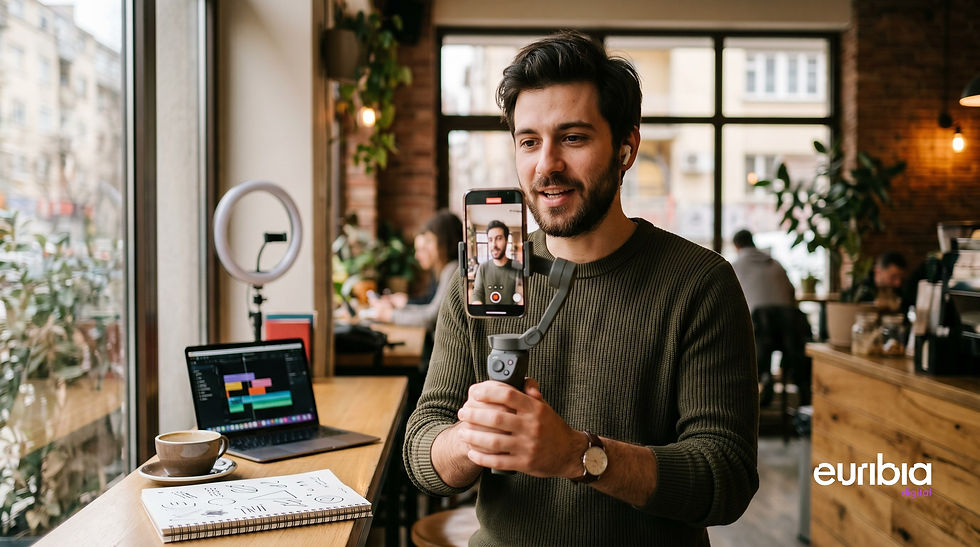
Polished ads stop working in 2026. Here is what replaces them, and why small budgets now have an edge over big ones.
Key takeaways
71% of TikTok users prefer brand content that does not look polished, and 65% say overly professional ads feel out of place in their feed (TikTok Marketing Science, 2025).
AI tools cut video production cost by roughly 90% versus traditional methods. Short vertical video is the highest-ROI channel for over 70% of marketers in 2026.
The new normal is volume over polish: 40 to 100 posts per month per brand, extracted from one or two anchor recordings multiplied across platforms.
If you are a Bulgarian SME competing for attention in 2026, the fastest path is the opposite of what most agencies still pitch. Stop budgeting for one expensive ad per quarter. Start producing five plus short vertical videos per week that look like a real person made them. AI tools, captioned editing, and one dedicated creator can deliver enterprise-grade volume on an SME budget.
Why this matters
Two structural shifts changed the math. First, social platform algorithms no longer favour established brands by default. New accounts in 2026 have an equal shot at organic reach if the content earns attention. Second, AI dropped production cost so far that the budget gap between a corporation and a five-person team stopped mattering. The bottleneck is no longer money. It is whether your content stops the scroll.
Meta’s auction data shows viewers decide whether to keep watching in about 1.7 seconds. Up to 50% drop off in the first three seconds (Meta video benchmarks, 2025). TikTok measures that 50% of the total impact on brand recall and ad performance happens inside the first two seconds. Videos that hold over 60% retention in those first three seconds perform 5 to 10 times better in total reach than videos under 40%. That gap is the difference between a video that hits hundreds of thousands and one that dies inside your own follower list.
Why polished ads stop working
The old model was simple. Produce one or two expensive clips per quarter, pay a big media budget to distribute them, and trust that production value would do the rest. In 2026, high production value actively hurts. Viewers scroll with a filter that flags polished, studio-lit content as a paid ad inside the first frame and skips on.
The psychology is direct. The viewer’s brain decides "ad or content" before the brain conscious processes a single word. If the answer is "ad", attention is gone. The only content that wins the next second is content that looks like a person made it for other people, not like a marketing team made it for an audience.
This is good news for Bulgarian SMEs. You do not need a studio. You do not need a cinema-grade camera. You do not need a famous director. You need to understand what holds attention in the first two seconds and the discipline to apply it consistently.
The 3 levers that actually work in short video
Lever 1: Earn the first 2 seconds
Your first frame, first line, and first motion are where the whole budget should go. A bold claim, a surprising visual, a direct address to camera, or a stat that interrupts the scroll. The test is simple: watch the first two seconds of your own video with the sound off. If nothing makes you want to keep watching, rewrite the opening.
Lever 2: Look like a person, not an ad
Direct to camera, natural light, shot on a phone, slightly imperfect audio. All of these signal authenticity and increase retention. Shopify reported that UGC-style ads reduced cost per click by up to 50% and produced 4x the CTR of professionally produced ads. Nielsen’s 2025 study found that 88% of viewers trust video testimonials as much as personal recommendations. The lesson is not "be sloppy", it is "be human".
Lever 3: Captions are non-negotiable
Around 85% of social video is watched without sound. Most caption users are not hearing-impaired, they are scrolling on a bus or in a meeting. Meta’s internal data shows captions add about 12% watch time. Instapage A/B tests found captioned videos got 17% more reactions, 16% more reach, and 5% more watch time. Assume the sound will be off and earn its return with a hook that works in silence.
How we actually run this for clients
The volume model looks simpler than people expect. Pick a team member who can talk on camera for 30 to 60 minutes about something they know cold. Record one anchor piece per week: a podcast clip, an expert interview, a founder monologue, or a behind-the-scenes walkthrough. Use a phone and a clip-on mic, not a studio.
Then extract 10 to 15 short clips per week from that one anchor. Add captions in batch via Opus Clip or Descript. Distribute across TikTok, Reels, Stories, LinkedIn, and YouTube Shorts on a fixed schedule.
AI carries the scale and the post-production. Veo, Kling, and Runway handle product visualisations and B-roll. Opus Clip and Descript handle clip extraction and captioning. ElevenLabs and Adobe Podcast Enhance get audio to studio quality from a phone recording. Canva and Midjourney cover routine graphics. The human handles the parts AI cannot fake: opinion, expert framing, the testimonial, the founder face.
A Bulgarian e-commerce client we run on this model produces 38 posts per month from one weekly 45-minute recording session. Total content cost dropped 76% versus their previous setup. Reach grew 4.2x in the first 90 days. The setup pays for itself before the second month.
Frequently asked questions
How many videos per month should a Bulgarian SME post in 2026?
The 2026 benchmark is 40 to 100 posts per month across all platforms combined. That is roughly 5 to 7 per week. Daily presence on TikTok, three to five Reels per week on Instagram, two to three short pieces per week on LinkedIn. The trick is one anchor recording multiplied into 10-15 clips, not 40 separate shoots.
Do we need expensive equipment to make video that works?
No. A modern phone with daylight from a window, a small gimbal, a clip-on mic, and a 10 EUR ring light covers 95% of what an SME needs. The single most valuable role to hire or contract is a strong editor, not a videographer with expensive gear. Phone footage edited well outperforms studio footage edited poorly every time.
Should we use AI-generated video?
Use it for product visualisations, atmospheric B-roll, and process animations. Veo, Kling, and Runway are excellent for these. Avoid AI-generated human faces in client-facing content. Viewers spot the artefacts instantly and trust collapses. The rule is AI for scale, humans for the emotional core like testimonials, founder presence, and expert opinion.
How long should a video be?
The sweet spot in 2026 is 30 to 90 seconds. Videos under one minute generate around 50% average engagement. Educational content under 60 seconds hits 79% retention. Videos over three minutes have dropped to roughly 45% retention. When in doubt cut earlier, not later.
What to do this week
Pick one team member who can talk on camera. Record a 60-90 second piece this week: direct to camera, phone, natural light, no script.
Extract 5 short clips of 15 to 45 seconds each from that recording. Add captions via Opus Clip or Descript.
Post the 5 clips across TikTok, Reels, and LinkedIn over the next 7 days. Track which gets the highest retention in the first 3 seconds. That is your hook formula.
Sources & further reading
TikTok Marketing Science Research, 2025 - first-2-second impact data
Meta video benchmarks, 2025 - 1.7-second scroll decision data
Shopify UGC ad performance study, 2025 - CPC and CTR data on UGC-style ads
Nielsen Trust in Advertising Report, 2025 - video testimonial trust data
Wistia State of Video Report 2025 - production-value vs engagement analysis
Get in touch
Have a question about your video setup or which AI tools fit your team? We usually respond within a few business hours.
Your next read

We build websites on both platforms for Bulgarian brands. Here is why we usually recommend Shopify, and when Wix Studio still wins. Honest 2026 take.


Comments